Compose visually
Create stateful nodes, connect them with relationships and define equations against explicit state and parameter references.
Konjugate is a visual modelling environment and native simulation engine. Components contain state, relationships define how they interact and results can be explored over time.
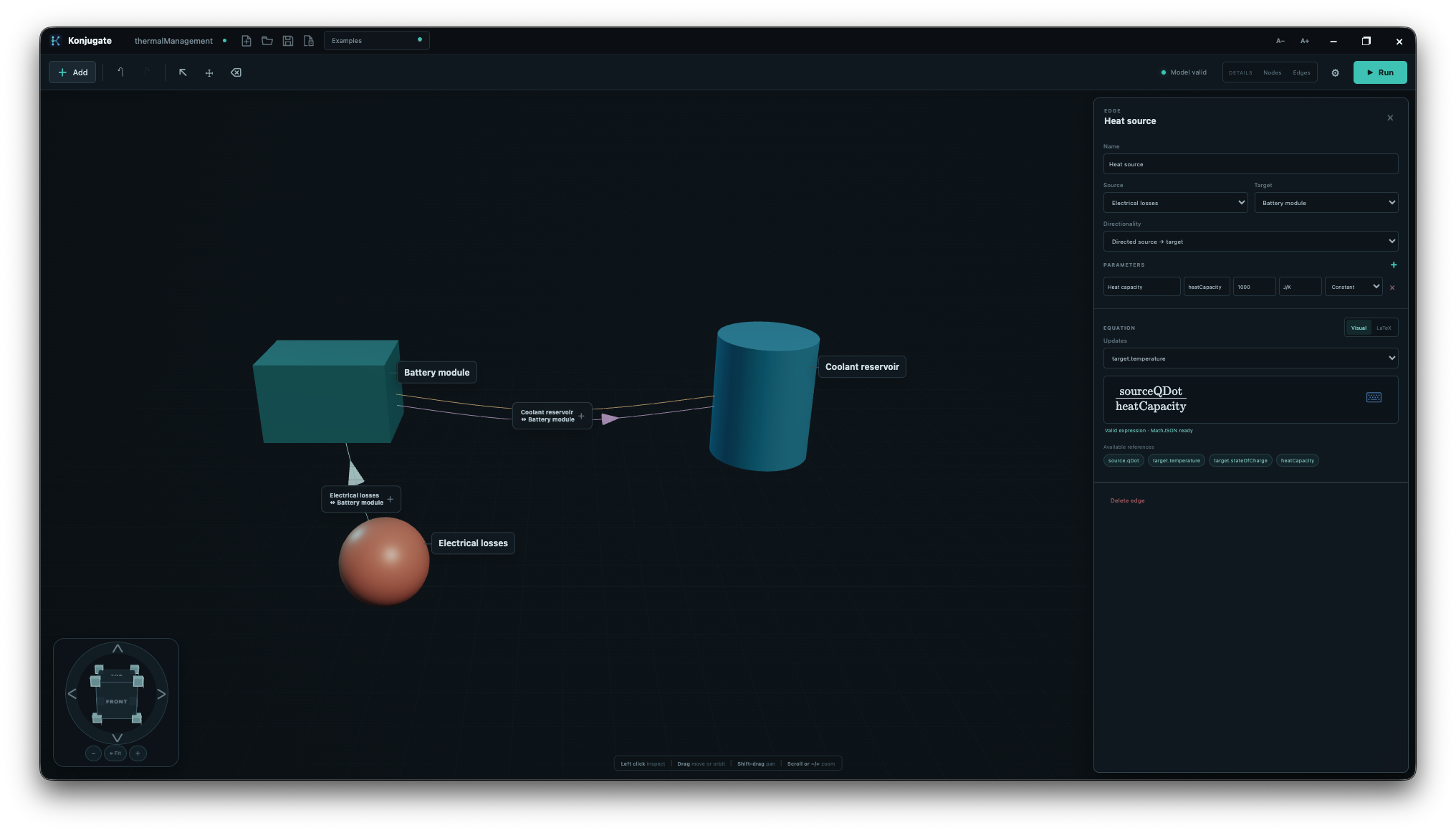
The model
Instead of assembling one monolithic system equation, describe the state owned by each component and the smaller interactions between components.
State evolution at node i
Practically speaking: a battery can own temperature and charge, a coolant reservoir can own temperature and fill level and their relationships can describe heat transfer or signals between them. The engine combines those local contributions at every synchronization step.
Available in the alpha
The current application already covers the complete path from a graph model to time-dependent results.
Create stateful nodes, connect them with relationships and define equations against explicit state and parameter references.
Use the same C++ validator from the desktop application or command line to reject structurally invalid or non-executable models.
Execute offline at maximum speed or pace an online simulation for live interaction, pausing and continuing at synchronization boundaries.
Scrub through results, inspect node values, compare signals on plots and extend a completed simulation from its final checkpoint.
Represent components with built-in forms or imported STL and STEP geometry without coupling appearance to model semantics.
Open live and completed results in permissioned visualizers contributed through a general add-on interface.
Direction
Konjugate is early-stage software. These are directions under exploration, not release promises.
Broaden solver capabilities, diagnostics and reproducible command-line workflows around the `.kjt` model.
Develop libraries of components, equations and examples without giving up the domain-agnostic data model.
Let specialised add-ons turn the same simulation data into plots, spatial scenes and domain-specific analysis experiences.
Open development
Follow the alpha, inspect the implementation or join the technical discussion on GitHub.